Evaluating the Social Media Post Tracker KDP Interior for Low-Content Publishing
The low-content and medium-content publishing market on Amazon KDP has evolved significantly, moving beyond simple lined journals toward specialized utility notebooks. Among these emerging categories, the Social Media Post Tracker KDP Interior represents a functional niche designed for content creators, influencers, and small business owners who prefer analog planning methods. When evaluating this specific interior template for your publishing portfolio, it is essential to understand not only what the product entails but also how it fits into a broader business strategy. This assessment covers the technical specifications, market viability, practical benefits, and necessary tradeoffs associated with utilizing pre-made tracker interiors in formats such as PDF, PowerPoint, Illustrator, EPS, and PNG.
Defining the Product and Technical Specifications
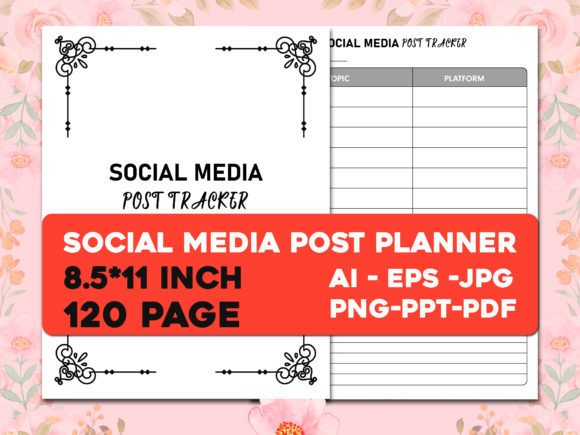
A Social Media Post Tracker KDP Interior is a structured layout designed to help users plan, schedule, and analyze their social media content without relying solely on digital tools. Unlike generic planners, these interiors include specific fields relevant to digital marketing, such as platform selection, hashtag tracking, engagement metrics, content pillars, and posting times. For publishers, the value proposition often lies in the versatility of the source files. A comprehensive download package typically includes editable AI (Adobe Illustrator) files, PPT (PowerPoint) files, EPS vector files, high-resolution PNG and JPG assets, and print-ready PDFs.
The inclusion of multiple file formats is a critical factor for evaluation. The 100 ready-to-upload PDF pages provide immediate utility for publishers looking to list products quickly. However, the editable AI and PPT files offer long-term value by allowing for customization. This flexibility enables publishers to alter fonts, adjust column widths, or rebrand the interior to create unique variations, which is increasingly important in a marketplace that penalizes duplicate content. The high-resolution nature of these files ensures that text remains crisp and lines remain sharp after printing, meeting Amazon’s quality standards for paperback production.
Market Viability and Niche Selection
Selecting the Social Media Post Tracker KDP Interior as a niche requires an objective look at current demand. This category sits at the intersection of productivity and digital marketing. While general planners are oversaturated, specialized trackers often face lower competition. The target audience for this interior is distinct: they are individuals who experience screen fatigue and seek tangible methods to organize digital workflows. This demographic values structure and data visualization over aesthetic minimalism.
When researching this niche, publishers should evaluate keyword search volume against the number of existing results. Terms related to "content calendar," "influencer planner," and "social media analytics journal" often indicate specific intent. A strong fit for this interior occurs when a publisher can identify a sub-niche gap, such as trackers specifically for real estate agents, Etsy sellers, or TikTok creators, rather than a generic "all-platform" approach. The pre-made template serves as a foundation, but market success usually depends on tailoring the metadata and cover design to a specific user persona.
Benefits of Pre-Made Editable Interiors
The primary advantage of acquiring a multi-format Social Media Post Tracker KDP Interior bundle is the reduction in development time. Designing a functional, aligned, and bleed-compliant interior from scratch requires significant graphic design expertise and hours of labor. Utilizing a tested template mitigates technical risks; files described as "fully tested" have presumably been verified for margin safety, gutter space, and resolution requirements, reducing the likelihood of rejection during the KDP upload process.
Furthermore, the availability of layered source files (AI and EPS) transforms a static product into a dynamic asset library. Publishers can extract individual elements, such as checkboxes or header graphics, to use in other projects. This modularity increases the return on investment for the template. From a workflow perspective, having both PDF and editable formats allows for a hybrid strategy: use the ready-made PDFs to test market demand quickly, then utilize the editable files to create improved versions based on customer feedback or competitive analysis.
Tradeoffs and Strategic Considerations
Despite the convenience, there are notable tradeoffs to consider. The most significant risk is market saturation due to accessibility. If a specific Social Media Post Tracker KDP Interior is sold to hundreds of publishers without restrictions on modification, the marketplace may become flooded with identical interiors. Amazon’s algorithms prioritize unique customer experiences, and duplicate content can lead to suppressed visibility or account warnings. Therefore, using the template "as-is" without customization is generally not a sustainable long-term strategy.
Another consideration is the learning curve associated with professional editing software. While PPT files are accessible to most users, maximizing the potential of AI and EPS files requires proficiency in Adobe Illustrator or compatible vector software. Publishers lacking these skills may find themselves limited to the basic PDF version, restricting their ability to differentiate their product. Additionally, pre-made templates may contain design choices that do not align with current trends. A tracker designed two years ago might lack sections for newer platforms like Threads or updated Instagram features, necessitating manual updates to remain relevant.
Situational Fit and Alternatives
This type of interior template is a strong fit for intermediate KDP publishers who understand niche research but lack advanced design skills. It is also suitable for established publishers looking to expand their catalog into the productivity niche rapidly. If your business model relies on volume and speed-to-market, and you possess the capability to modify source files to ensure uniqueness, this resource aligns well with operational goals.
Conversely, alternatives may be worth considering for beginners with zero design budget or advanced designers seeking total originality. Beginners might benefit more from free, open-source templates or simpler Canva-based designs to learn the basics of KDP formatting before investing in premium bundles. Advanced designers may find greater long-term value in creating proprietary interiors from scratch, ensuring 100% uniqueness and avoiding licensing ambiguities. Additionally, if market research indicates that the target audience prefers digital planning (e.g., Notion templates or iPad planners), a physical KDP book may not be the optimal product format regardless of interior quality.
Making an Informed Decision
Ultimately, the decision to utilize a Social Media Post Tracker KDP Interior should be driven by data rather than convenience. Evaluate the specific contents of the download against your technical capabilities and market findings. Verify that the license permits commercial use and modification for KDP. Assess whether the included layouts address current pain points for social media managers or if they require significant updating.
Treat the template as a starting point rather than a finished product. Success in this niche comes from combining the efficiency of pre-made assets with the strategic insight of targeted niche research. By customizing the interior, optimizing keywords for specific user segments, and ensuring high-quality cover design, publishers can leverage these resources to build a sustainable portfolio. The goal is to provide genuine utility to the end-user, transforming a generic tracker into a valuable tool for digital organization.