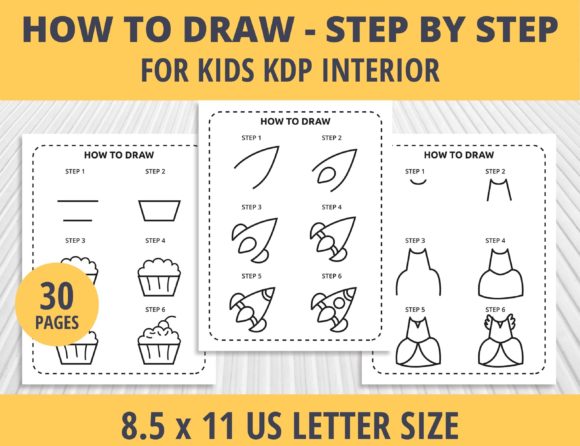
Evaluating How to Draw for Kids Easy 6 Steps KDP Resources for Self-Publishing
Creating a successful low-content or medium-content book on Amazon KDP requires balancing quality, production speed, and market fit. For publishers targeting the children’s activity niche, the "How to Draw for Kids Easy 6 Steps KDP" resource package represents a specific category of pre-made interior assets. Unlike generic coloring pages or complex illustration tutorials, this format focuses on a standardized pedagogical structure that breaks down complex subjects into manageable geometric progressions. Understanding the technical specifications and strategic application of this 30-page, 8.5 x 11-inch asset pack is essential for determining whether it aligns with your publishing goals or if alternative methods would yield better long-term results.
Defining the Asset Package and Technical Specifications
The core value proposition of this specific resource lies in its versatility and file accessibility. When evaluating this product against other KDP interiors, the inclusion of an editable PowerPoint source file is a significant differentiator. Many competing products offer only flattened PDFs or high-resolution JPGs, which limits a publisher's ability to customize content, adjust margins for bleed, or rebrand the interior. The PowerPoint format allows users to manipulate individual elements, change fonts, add branding, or combine pages without requiring advanced graphic design software like Adobe Illustrator or Affinity Designer.
The package typically includes three distinct file types: an editable PPTX, high-quality JPGs, and a print-ready PDF. This multi-format approach addresses different workflow needs. The PDF serves as an immediate solution for publishers who want to upload a compliant 8.5 x 11-inch interior without modification. The JPG files offer flexibility for creating marketing mockups, A+ Content, or social media promotions. Meanwhile, the source file provides the longevity required for building a sustainable brand rather than just releasing a single generic title. The 30-page count is also strategic; it provides enough substance to be perceived as a complete workbook while remaining thin enough to keep printing costs low, thereby protecting royalty margins on lower-priced children's books.
Pedagogical Structure Versus Generic Activity Books
When comparing "How to Draw for Kids Easy 6 Steps KDP" resources to general art instruction books, the distinction lies in cognitive load management. Standard drawing books often present a finished image alongside a brief description, leaving the child to bridge the gap between simple shapes and complex forms. The six-step methodology deconstructs this process into incremental visual cues. Step one usually establishes basic geometry, steps two through four add defining features, and steps five and six refine details and encourage coloring.
This structured approach offers higher perceived value to parents and educators compared to unstructured sketchbooks. From a KDP perspective, this structure reduces customer returns and negative reviews related to difficulty level. However, publishers must evaluate whether the specific six-step progression included in the asset matches their target age group. A six-step breakdown designed for ages 8–12 may be too detailed for toddlers, while one designed for preschoolers may lack sufficient challenge for early elementary students. The editability of the source file becomes crucial here, allowing publishers to simplify or complicate steps to match their specific niche research.
Tradeoffs: Pre-Made Assets Versus Custom Illustration
A critical decision factor for KDP publishers is choosing between pre-made assets like this 6-step pack and commissioning custom illustrations or using AI generation tools. Each path presents distinct tradeoffs regarding cost, time, and uniqueness.
- Cost Efficiency: Pre-made packs are significantly cheaper than hiring illustrators. A custom 30-page drawing book could cost hundreds of dollars in freelance fees, whereas asset packs are a fraction of that price. This lowers the barrier to entry and financial risk for new publishers.
- Speed to Market: With ready-to-use PDFs and editable sources, a book can be formatted and published in days rather than weeks. This is advantageous for capitalizing on seasonal trends or testing new niches quickly.
- Saturation Risk: The primary downside of pre-made assets is non-exclusivity. Other publishers have access to the same "How to Draw for Kids Easy 6 Steps KDP" files. Without significant customization, books may look identical on the marketplace, leading to price wars and reduced visibility.
- Quality Control: While high-quality JPGs are included, vector-based source files are superior for resizing. If the provided PPT uses raster images, scaling up to larger trim sizes may result in pixelation. Publishers must verify the resolution and vector status before committing to a trim size change.
In contrast, custom illustration guarantees uniqueness and potential copyright ownership but requires higher upfront investment and longer lead times. AI-generated art offers a middle ground but currently struggles with the precise, logical consistency required for six-step instructional sequences, often producing nonsensical intermediate steps that confuse young learners.
Strategic Customization and Trim Size Adaptation
The ability to resize files is frequently mentioned in product descriptions, but practical execution requires careful attention. The native 8.5 x 11-inch format is the industry standard for children’s activity books, offering ample workspace for small hands. However, some publishers prefer 8 x 10 or square formats to differentiate their listings. When utilizing the editable PowerPoint source to alter trim sizes, several technical considerations arise.
First, margin safety zones shift when dimensions change. Elements positioned safely within the live area at 8.5 x 11 may fall into the gutter or bleed zone at 8 x 10. Second, aspect ratio changes can distort circular shapes, making animals or objects appear stretched or squashed. Publishers should treat the source file as a template rather than a final product when resizing. It is often more effective to rearrange elements onto new slide masters set to the desired trim size rather than simply stretching the existing canvas. This ensures that the six-step progression remains visually balanced and professionally presented.
Furthermore, combining this resource with other KDP interiors can enhance value. A standalone drawing book is common, but integrating these 6-step lessons into a broader educational workbook—such as a "Learn to Read and Draw" or "Nature Study Journal"—creates a unique selling proposition. The PowerPoint format facilitates this hybrid approach by allowing publishers to intersperse drawing pages with lined writing paper, fact sheets, or coloring scenes from other asset packs.
Determining Fit: When to Use and When to Avoid
This specific type of resource is best suited for publishers who view pre-made content as a foundation rather than a finished product. It is ideal for those building a series where consistent formatting matters more than exclusive artwork, or for testers validating demand in a sub-niche like "how to draw ocean animals" before investing in custom design. It also serves established publishers looking to backfill their catalog during busy seasons when creative bandwidth is limited.
Conversely, this option may not be appropriate for publishers aiming to build a premium, trademarked character brand. If the goal is to create a recognizable mascot or proprietary teaching method, relying on shared assets will dilute brand equity. Additionally, publishers who lack basic proficiency in PowerPoint or layout principles may find the "editable" aspect challenging. Modifying master slides, managing layers, and ensuring consistent alignment across 30 pages requires a baseline level of desktop publishing competence. In such cases, a non-editable but perfectly formatted PDF might be safer, or outsourcing the customization to a virtual assistant familiar with KDP specifications.
Evaluating Long-Term Viability and Licensing
Before acquiring any "How to Draw for Kids Easy 6 Steps KDP" package, thorough license verification is mandatory. Not all commercial licenses are equal. Some restrict the number of units sold, prohibit use in subscription services, or require attribution. Others may forbid combining the assets with other free or purchased elements to create derivative works. Understanding these terms prevents future account issues and legal complications.
From a market sustainability perspective, publishers should assess the evergreen nature of the included subjects. Animals, vehicles, and basic shapes maintain steady search volume year-round. Trend-based subjects may generate quick sales but risk obsolescence. Because the asset pack contains a fixed set of 30 pages, publishers should calculate whether the per-page cost justifies the potential earnings. If the pack costs $15 and generates $2 royalties per book, breaking even requires selling eight copies. However, if the content is customized sufficiently to command a higher price point or generate repeat customers, the ROI improves significantly.
Ultimately, the decision to use this resource should stem from a clear publishing strategy rather than convenience alone. By leveraging the editable nature of the source files, respecting the pedagogical intent of the six-step format, and thoughtfully combining assets to create unique value, publishers can effectively integrate this tool into a professional KDP portfolio. The key is to treat the "How to Draw for Kids Easy 6 Steps KDP" package as a professional component in a larger production workflow, ensuring that the final product meets both platform standards and customer expectations for quality educational content.