Kids Vacation Journal for Summer KDP: A Strategic Asset for Modern Publishers
The landscape of low-content and medium-content publishing on Amazon KDP has shifted significantly in recent years. Gone are the days when simply uploading a generic lined notebook guaranteed sales. Today’s market demands specificity, utility, and professional presentation. For publishers targeting the family travel niche, a dedicated Kids Vacation Journal for Summer KDP represents more than just a seasonal product; it is a foundational asset that addresses the growing parental desire for screen-free engagement and tangible memory keeping. This specific type of interior bridges the gap between entertainment and education, offering a structured yet creative outlet for children during travel.
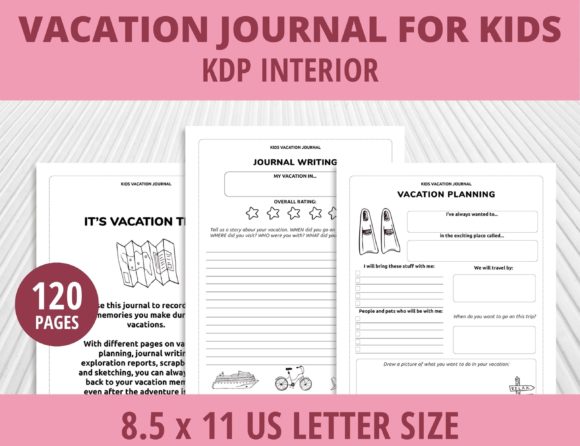
Relevance in this niche is driven by user intent. Parents and educators are actively seeking tools that transform passive travel time into active learning experiences. A well-designed vacation journal serves this dual purpose effectively. However, the true value for KDP creators lies not just in the concept, but in the technical execution and versatility of the source materials. When you acquire a comprehensive package that includes an editable source file EPS, a high-quality JPG file, and a PDF file with 120 pages at 8.5 x 11 inches, you are securing a flexible production pipeline rather than a single static product. This adaptability is crucial for maintaining competitiveness in a saturated marketplace where differentiation is key to long-term profitability.
Evolving Market Expectations in Children’s Activity Books
Consumer behavior regarding children's activities has undergone a notable transformation post-pandemic. There is a heightened awareness among millennial and Gen Z parents regarding the developmental impacts of excessive screen time. Consequently, the demand for analog alternatives has surged, but with a caveat: these alternatives must be engaging enough to compete with digital entertainment. The modern Kids Vacation Journal for Summer KDP must offer interactive prompts, space for creativity, and age-appropriate challenges that feel like play rather than homework.
This shift has redefined quality standards. Buyers now scrutinize "Look Inside" previews and A+ content more rigorously. They expect cohesive design systems, legible typography, and illustrations that resonate with contemporary aesthetics. Generic clip art assemblies no longer suffice. The availability of an editable source file EPS allows publishers to meet these elevated expectations by customizing elements to fit specific sub-niches or branding guidelines. Whether adjusting the complexity of prompts for different age groups or updating visual themes to match current trends, the ability to modify the core asset ensures the final product remains relevant to evolving consumer preferences.
The Strategic Advantage of Resizable Interiors
One of the most significant operational advantages in KDP publishing is trim size agility. Travel journals do not exist in a vacuum; they compete within a broader ecosystem of activity books, sketchbooks, and educational workbooks. While 8.5 x 11 inches is a standard format that offers ample space for drawing and writing, it is not always the optimal choice for every customer segment. Portability is often a primary concern for families packing for summer trips. Smaller formats like 6x9 or even 5x8 may be preferred for backpacks and carry-on luggage.
Having files that can be resized to your desired trim size eliminates the need to purchase multiple distinct interiors or attempt complex manual reformatting. This capability streamlines the creation of product variations, allowing you to test market preferences without significant additional investment. You might release the 8.5 x 11 version as a comprehensive "Ultimate Summer Journal" while simultaneously offering a compact 6x9 edition marketed specifically as a "Travel-Friendly Road Trip Companion." This multi-format approach maximizes keyword coverage and captures diverse buyer intents using the same core intellectual property.
Maximizing Utility Through Modular Design Integration
A critical feature of high-value KDP assets is interoperability. The prompt notes that this Kids Vacation Journal for Summer KDP can be used as-is or put together with other KDP interiors. This modularity is essential for creating unique value propositions. In a marketplace where many sellers utilize similar base templates, the ability to combine distinct interiors creates a proprietary product that cannot be easily replicated by competitors using the same stock assets.
Consider the practical application of combining a vacation journal with complementary interiors:
- Educational Add-ons: Integrate geography worksheets, language basics for destination countries, or nature identification guides to create a "Learning Through Travel" bundle.
- Creative Expansion: Combine the journal with specialized coloring pages, sticker activity zones, or comic strip templates to appeal to artistically inclined children.
- Planning Tools: Merge with kid-friendly itinerary planners or packing checklists to position the book as a pre-trip preparation tool as well as an in-trip record keeper.
- Mindfulness Components: Include gratitude logs or emotion tracking pages to address the social-emotional learning trend that continues to gain traction in parenting circles.
This combinatorial strategy extends the product lifecycle beyond the peak summer season. By integrating evergreen educational or creative elements, the journal maintains relevance during spring break, winter holidays, or even as a general weekend activity book. The 120-page count provides substantial room for such expansion without making the book feel thin or overpriced, supporting a higher perceived value and potentially better royalty margins.
Technical Specifications and Production Efficiency
For professional publishers and freelancers managing multiple titles, workflow efficiency directly impacts profitability. The inclusion of specific file types addresses different stages of the production and marketing process. Understanding how to leverage each format is essential for maximizing return on investment.
The PDF File with 120 Pages serves as the immediate production-ready master. At 8.5 x 11 inches, it is formatted for direct upload to KDP, minimizing setup time for quick launches. This is ideal for capitalizing on seasonal trends where speed-to-market is critical. The page count strikes a balance between substance and cost-effectiveness, providing enough content to justify a competitive price point while keeping printing costs manageable.
The High-Quality JPG File is invaluable for marketing and listing optimization. Rather than relying solely on digital mockups, publishers can use actual interior spreads in A+ Content, social media promotions, or advertising creatives. Showing real page layouts builds trust with buyers who want to verify age-appropriateness and design quality before purchasing. High-resolution imagery reduces return rates and negative reviews stemming from unmet expectations.
Most importantly, the Editable Source File EPS represents long-term asset ownership. Unlike flattened PDFs, vector-based EPS files allow for infinite scaling without quality loss and complete element manipulation. This means you can update copyright years, modify branding, adjust margins for different bleed requirements, or completely overhaul the color scheme for future editions. For entrepreneurs building a recognizable series or brand identity, this editability transforms a one-time purchase into a sustainable product line foundation.
Practical Implications for Diverse Creator Profiles
The versatility of this asset makes it applicable across various professional and personal contexts within the KDP ecosystem. Understanding these applications helps creators align the product with their specific business models and audience needs.
For Educators and Homeschoolers: The journal can be positioned as a summer learning retention tool. By emphasizing the reflective and observational aspects of journaling, educators can market the book as a way to prevent the "summer slide" in literacy and critical thinking skills. The editable nature allows teachers to customize prompts to align with specific curriculum standards or local field trip destinations.
For Travel Bloggers and Influencers: Those with established audiences in the family travel niche can use this journal as a branded merchandise opportunity. Customizing the cover and select interior pages to match their blog’s aesthetic creates a cohesive brand experience. It serves as both a revenue stream and a community-building tool, offering followers a tangible way to engage with the creator’s travel philosophy.
For Freelance Designers and Virtual Assistants: This asset package can serve as a white-label solution for clients entering the KDP space. The ability to resize and combine interiors allows designers to offer comprehensive publishing services without starting from scratch. Delivering a customized, multi-format product suite demonstrates professional value and justifies premium service pricing.
For Hobbyists and Side Hustlers: The low barrier to entry provided by ready-made, customizable assets allows newcomers to learn the KDP platform with reduced risk. Starting with a proven structure like a vacation journal provides a framework for understanding market dynamics, keyword research, and listing optimization before investing in custom illustration or complex content creation.
Navigating Seasonality and Evergreen Potential
While "Summer" is explicitly mentioned in the title, successful KDP publishers think beyond seasonal limitations. The underlying mechanics of a vacation journal—observation, recording, creativity, and reflection—are universally applicable. The key to extending sales velocity lies in strategic positioning and minor modifications enabled by the editable source files.
During off-peak months, the same interior can be reframed. Change the cover title to "Family Adventure Journal," "Weekend Explorer’s Log," or "Road Trip Memory Book" to capture year-round travel traffic. The prompts can be slightly adjusted to focus on local exploration rather than distant destinations. This pivot requires minimal effort when working with vector source files but significantly expands the total addressable market.
Furthermore, consider bundling strategies. Pairing the summer journal with back-to-school preparation materials in late July creates a transitional product that appeals to parents managing end-of-summer logistics. Alternatively, combining it with holiday-themed interiors in Q4 creates a "Year of Adventures" compilation. These strategic combinations leverage the modular nature of the asset to maintain consistent revenue streams regardless of calendar season.
Ultimately, success with a Kids Vacation Journal for Summer KDP depends on treating it as a dynamic business asset rather than a static commodity. The combination of technical flexibility, market-aligned content, and combinatorial potential provides a robust foundation for sustainable publishing. By focusing on genuine user needs, maintaining professional quality standards, and strategically leveraging the included file formats, creators can build products that deliver real value to families while establishing resilient income streams in the evolving digital publishing landscape.